MyWestern
 Academic Calendar
 Bookstore
 University Catalog
 Athletic & Recreational Venues
 MyWestern
 Academic Help
 Library
 Health & Wellness
 Campus Map
 Events

Why Writers Should Take Field Trips
Poet and Western faculty member Erica Reid explores why field trips for writers can be as valuable as any workshop or conference, drawing on a watershed tour along Colorado’s North Fork of the Poudre River to show how new landscapes, vocabularies, and conversations feed a writing life.
As a passionate writer, an avid reader, a volunteer editor, a Poetry & Nature Writing teacher, and an active Poet Laureate of my city, most of my focus revolves around writing. It can often take a good deal of effort and advance planning to make sure I spend a day or two away from my desk, immersed in something new — and when I do take a field trip, my writing is always better for it.
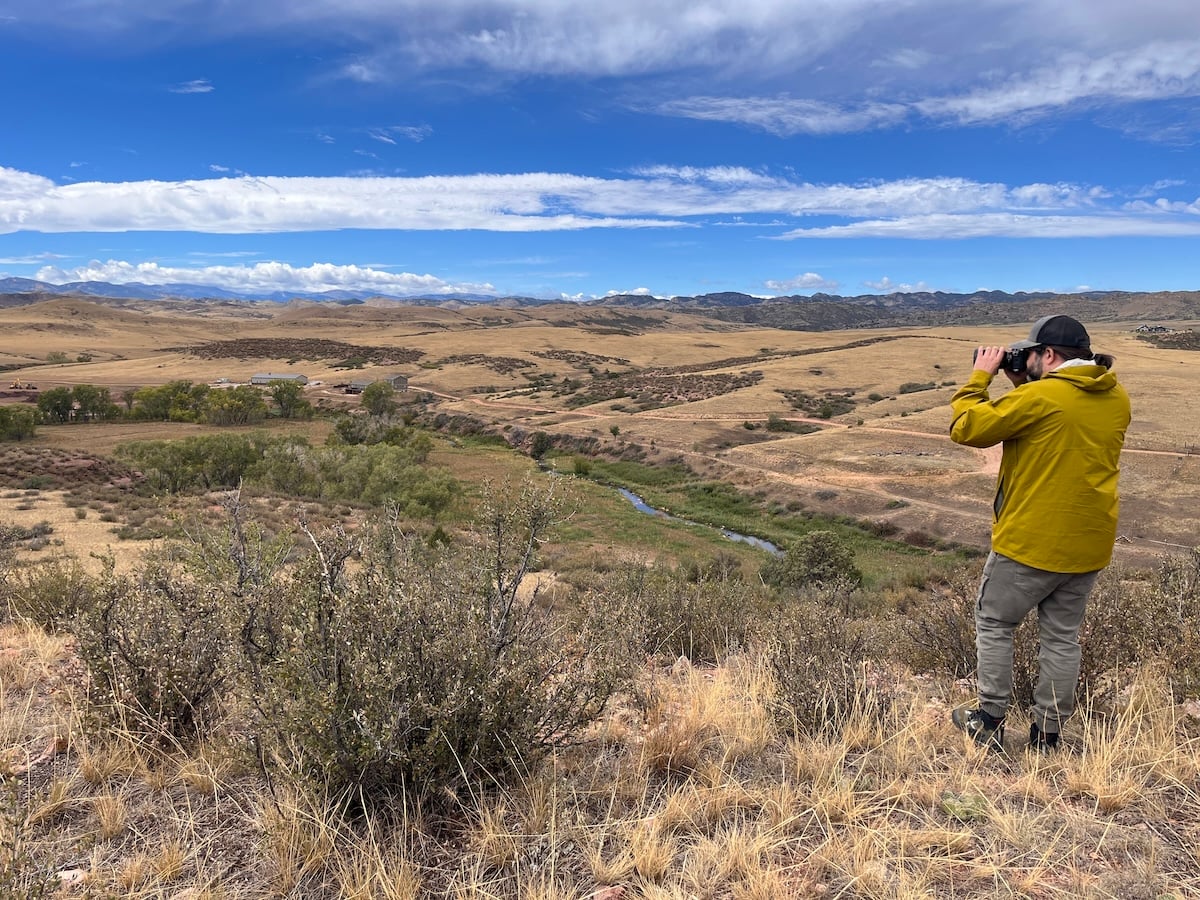
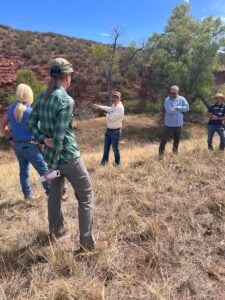
As one of my field trips, I recently attended the North Fork Poudre River Healthy Watershed Tour, an annual collaboration between local agencies that care about and steward the areas surrounding our rivers and streams. Though the event is open to the public, it is almost exclusively attended by conservationists, scientists, and local landowners — and that’s part of what makes it an ideal setting for a writer.
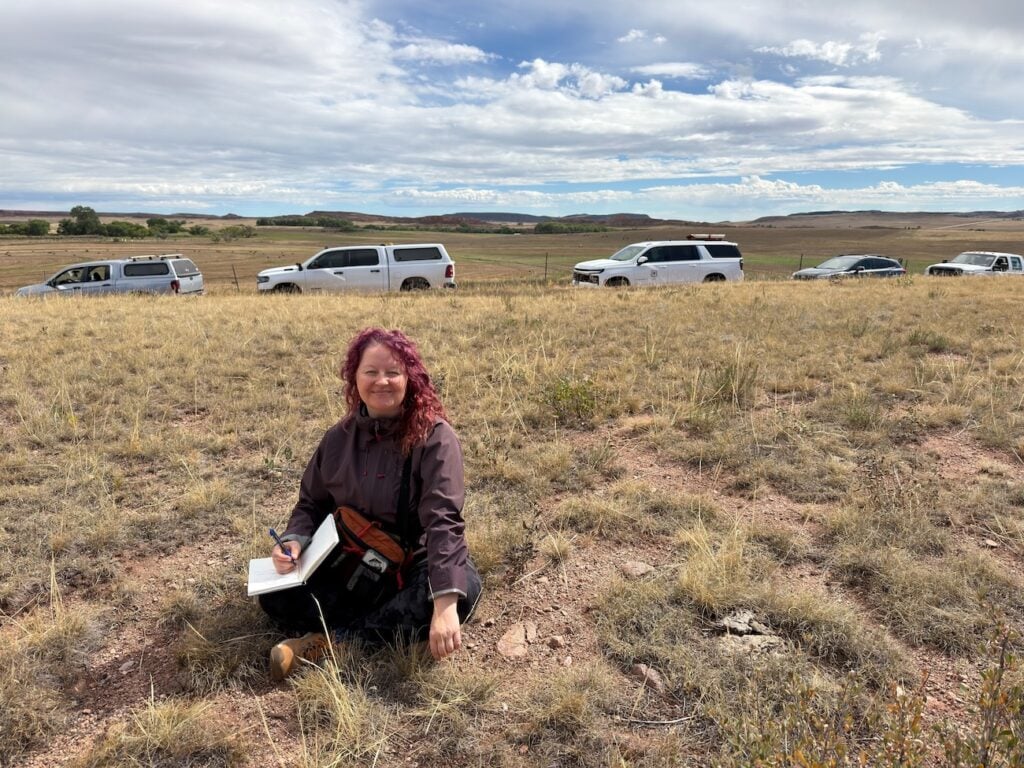
If you find yourself attending mostly writer-oriented workshops and readings, or spending too much time tethered to your desk, here are a few reasons I recommend getting out of your wheelhouse once in a while.
Gather Textures
A true sense of landscape is insanely difficult to render without having actually experienced it for oneself — and a reader can feel that inauthenticity.
My experience wandering local ranches provided me with a lush list of new textures to draw from — willows and cottonwoods, mullein, hayfields, red-tailed hawks. Even better, I walked away with a heap of new vocabulary to roll around in, such as riparian fringe, Zeedyk structures and zuni bowls, eDNA, induced meander.
What new phrases and textures could you gather at a firehouse? Your local historical archive? A botanic garden?
Meet Your Co-Conspirators
As a writer myself, I spend no small amount of (joyous!) time in the company of other writers and educators. It is far less often that I find myself making conversation with, say, cattle ranchers or wetlands restoration volunteers.
During our watershed tour, I spoke with passionate members of agencies including the U.S. Forest Service, the Nature Conservancy, and Colorado Parks and Wildlife. I heard directly from local landowners, a representative from our State Land Board, and a member of The Ember Alliance, a local non-profit focused on “restoring peoples’ relationships with fire.” Because the tour was organized as a carpool, I ended up spending an hour chatting with a local farmer as well as a National Parks employee who researches dark skies and light pollution.
And just as they served as ambassadors for their fields, I found myself representing poetry — they were all just as interested to see where our work intersects as I was.
Develop New Questions
The longer our writing careers, the more likely we are to return to similar questions. It can also be healthy to step outside of those internal obsessions and discover other questions the world might be asking. A few new questions that I walked away with:
- When does the natural world benefit from our help, and when might we step out of the way?
- Some ranches are using collars and “cattle geofencing” instead of physical fences — what other farm and ranch technology don’t I know about?
- How does a habitat heal after a semi truck spills an entire tank of milk all over it? (Apparently, this actually happened.)
Any one of these questions might be the start of an essay, a poem, or a deep conversation over cocktails.
See the World As It Truly Is
Have you spent so much time behind your laptop/notebook/typewriter that you’ve forgotten to actually engage with the world you’re writing about? A field trip outside of your normal stomping grounds can help you “touch grass,” as they say — to step away from the desk for a few hours, while still feeding your inner writer.
See the World As It May Be in the Future
For me, the single greatest result of my field trip was that I left with a renewed sense of hope. I spent my Saturday surrounded by people whose careers and even lives are dedicated to making a very specific corner of the world — the North Fork of the Poudre River — better through small but intentional acts of service, volunteerism, dedication, and attention.
When asked how soon he expected to see results for one of his habitat improvement projects, one ranch owner admitted it might take a decade or two. He still knew it was worth his effort. I hadn’t even known how much I needed to hear that.
My sense is that any such tour or event organized by people who truly care about a cause will net a similar result.
For you, it may not be a river — find your own group of rabblerousers who are eager to show you how they are improving their backyards. I dare you not to walk away uplifted; it will be harder than you think.
Be Delighted
This field trip was not valuable because I might milk a poem out of it — it was valuable because of the sheer delight I experienced, which made me want to rush home and explore it again through my own writing. It connected me to my local community, exposed me to new ideas, introduced me to sweeping vistas, and invited me into the sunshine.
Once in a while, consider swapping a writing conference or workshop for an out-of-the-box field trip. Your writing mind will thank you.
Places to Search for Field Trips
Your field trip can be anywhere — a new-to-you museum, an overlooked park, a volunteer day with a school or business. If you’re looking to branch out, here are a few places to poke around:
- Historical societies
My local society offers events with fascinating titles such as “From Sugar Beets to Silicon: The History of Industry in Fort Collins” - Local nonprofits
I discovered my specific tour through the Coalition for the Poudre River Watershed, but most areas are teeming with nonprofits that are beyond eager to tell you about — and involve you in! — their great work - Government agencies
Your mind might first think national, but in my region, my state, city, and county offer a great deal of civically-minded events. For example, the city of Fort Collins offers a “CityWorks 101” that includes tours of water treatment plants, and my county has its own Conservation Corps that hosts events
Erica Reid is a poet and member of the Poetry and Nature Writing faculty in Western’s Graduate Program in Creative Writing, where she earned her MFA in 2022. She is the author of Ghost Man on Second, winner of the Donald Justice Poetry Prize, and her second collection, How Prey Thinks, is forthcoming in 2028. Her poems have appeared in Rattle, Terrain.org, Shenandoah, Colorado Review, and elsewhere, and she is a 2026 Pushcart Prize recipient and a current Poet Laureate of Fort Collins, Colorado.
Meet the Expert
Erica Reid
Poetry & Nature Writing Faculty
Erica Reid is the author of Ghost Man on Second, winner of the Donald Justice Poetry Prize (Autumn House Press); her second full-length poetry collection,…
MA or MFA in Creative Writing
Interested in growing as a writer? Western’s low-residency Graduate Program in Creative Writing offers MA and MFA degrees with concentrations in Nature Writing, Genre Fiction, Poetry, EcoPoetry, Publishing, and Screenwriting.
Related Stories