MyWestern
 Academic Calendar
 Bookstore
 University Catalog
 Athletic & Recreational Venues
 MyWestern
 Academic Help
 Library
 Health & Wellness
 Campus Map
 Events

Deep Time for Decision Making
What does deep time ask of us? Master of Environmental Management Director Dominique Naccarato weaves together the Grand Canyon’s ancient rock, the legacy of uranium mining in Church Rock, and Diné teachings on balance to consider how we might plan across timescales far longer than our own.
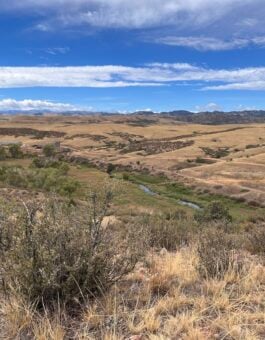
It’s 2025. I’m with Master of Environmental Management graduate students under a shade structure in the sweltering, late June heat in Church Rock, New Mexico. The sky rests its full blue weight atop rock formations, which are layered maroon, gold, and purple. The maroon and purple indicate the Morrison Formation, the food source for nearby uranium deposits. Quintessential Northern New Mexico puffy clouds drift and amble across. The sky is impossibly bigger than the sum of its parts.
Uranium mining’s short heyday in the US began just before the time of the Manhattan Project in 1942 and declined in the late 1980s with the end of the Cold War. There was little planning for waste rock and tailings storage, or the communities impacted.
“We worked in the mine without any protection from the radioactivity,” says one of the Diné elders speaking with us.
“Me, too,” says another. “They just sent us down there; we were in high school. They knew, but they didn’t tell us.”
They go on to list those who went into the mine with them but are no longer here. Brothers, sisters, cousins, and friends who’ve died from cancer related to their exposure to radioactivity.
“We played in the streams and creeks that formed from the flood,” says another woman who is about my age. She is old enough to remember the hard rain that caused the dam breach at the United Nuclear Corporation’s uranium tailings lagoon in 1979. I can imagine the heat, and the temptation to play in the water. The dam breach sent tailings downstream through formerly dry arroyos as far as Window Rock, Arizona. Radioactive waste traveled almost 50 miles away, impossible to ever clean up. United Nuclear did not tell the parents to keep their children or livestock away from the floods.
She tells us about children who are still getting sick. I wonder if they are her children or grandchildren. I wonder if they are sick from direct exposure to radiation that still exists in her community, their young cells dividing more frequently and thus developing leukemia or thyroid cancer by age 10. I also wonder about the genetic defects these children suffer due to their parents’ and grandparents’ direct exposure.
I look back up at the blue sky, as if it can give answers.
Meeting Deep Time in the Grand Canyon
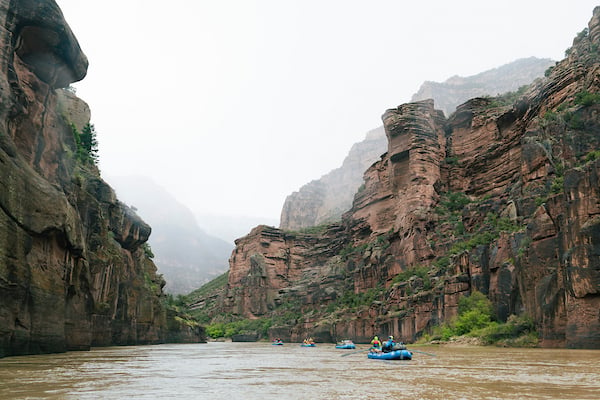
I conjure a memory: It was 1997, and I was many miles downstream from Church Rock in the Grand Canyon of the Colorado River. Like the canyon plants, we waited each day for the January sun to warm us at the bottom of the gorge. The deep canyon walls variegated vertically by rock layers, and horizontally by light and shadows. At 20 years old, I was forging the lonely road into adulthood.
“You never say no to a Grand Canyon invite, even in January,” said my sister, and so I found myself rafting the “Big Ditch” over the holidays.
I learned immediately that the canyon didn’t care whether I succeeded or failed in my journey to adulthood, or that my hands cracked and bled in the dry, cold air. I’d just suffered my first flip and sobbed uncontrollably at camp over this loss of innocence. How could the river do that to me?
Entering the Upper Granite Gorge, we were 77 miles and many days from our starting point at Lee’s Ferry. My polypropylene long underwear under my drysuit had gained a pungent level of ripeness formerly unknown to me. The river sliced deep into the heaving layers of rock.
“Around the next bend, we’ll see the Vishnu Schist basement layer. It’s around two billion years old,” shouted our trip leader.
“So just a little younger than you?” I quipped.
As we passed by the rock layer, I felt the cold emanations of outer space condensed by billions of years of pressure. Mysterious and terrifying, the Vishnu Schist seemed to be engaged in an endothermic reaction with all of life, sucking in any nearby heat and light. I felt sure that if I touched it, it would freeze my arm or perhaps suck me in like a black hole. Inside the rock, tiny zircon-uranium clocks ticked away deep-time, as the uranium inside decayed into lead.
I remember shivering in wonderment at something so old.
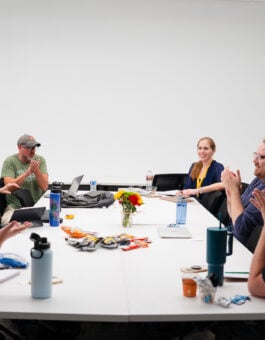
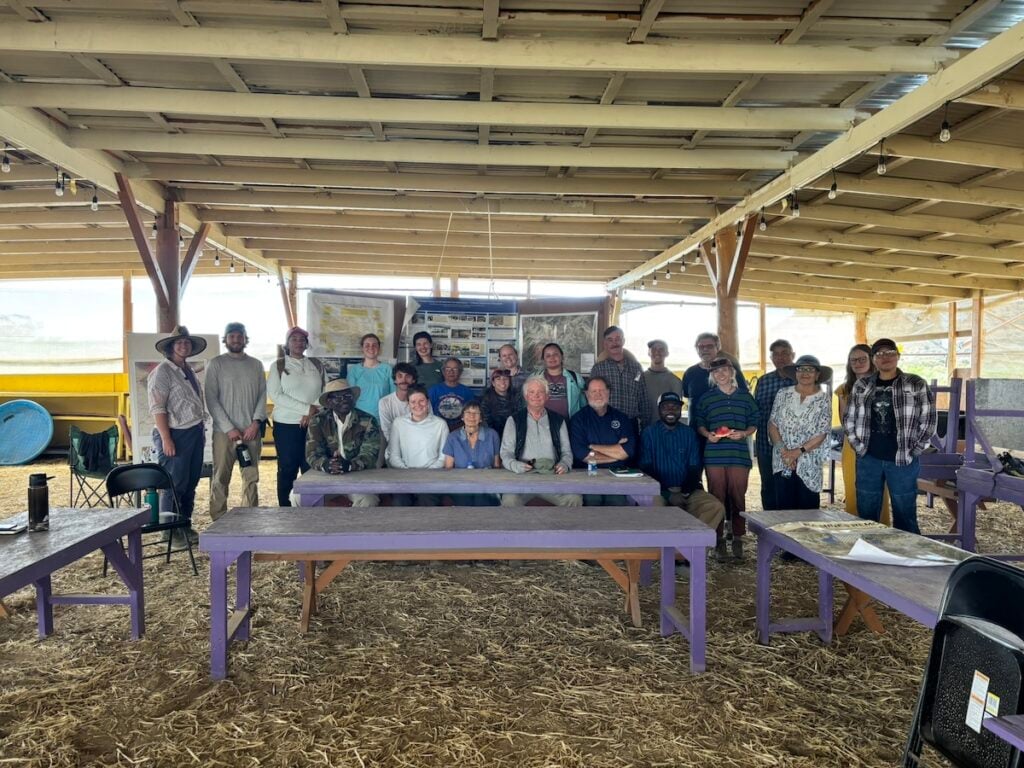 Master of Environmental Management students and Church Rock community members come together during a 2025 visit centered on listening and shared learning.
What Is Deep Time?
Deep time is the 4.54 billion years stretch of earth’s geological history that defies human temporal understanding. According to the Smithsonian Human Origins Program, deep time is a framework that helps humans understand how we arrived at our present moment. But deep time provides a variety of lenses, not just for understanding time, space and science, but for understanding our position in earth’s history and our human timescale choices.
Later in life, through my environmental management work, I’ve learned that while a river can slowly, patiently erode the rock and expose deep time, the process of humans mining uranium is a much more violent and immediate affair. Through my work, I’ve learned many things I sometimes wish I could unknow, returning to the simple betrayal of the whitewater raft flips of my youth.
I don’t pretend to know her life, but I bet the Diné woman who spoke of her children will remember growing up in the Cold War. I remember wishing for bunkers to protect our families and ourselves if Russia sent a nuclear missile to destroy us. Now, as life’s rivers carve my personal decision-making formations, my fears have shifted form but never disappeared. Climate destabilization, drought, weather whiplash, and fascism in our own country have replaced the fear of nuclear annihilation.
Uranium mining is now ramping back up even though we still don’t know how to clean up the waste. Nuclear energy is being implemented as energy transition and powering the eruption of new data centers for artificial intelligence. Regulations around mining and treatment of mine-waste have changed since 1979, but with a half-life of around 700 million to 4.5 billion years, uranium doesn’t care about election cycles, corporate or human timelines.
Planning for Timescales Beyond Our Own
Back under the shelter in Church Rock, I feel the Grand Canyon return to me–not just the scenery, but the scale. My students and I are offered juicy watermelon and other fruits from this community who give generously of their time. We wonder if the fruits are radioactive. We eat it anyway as a courtesy and because it’s deliciously cooling.
We learn about Diné philosophy that human beings are meant to live in a state of balance, harmony, beauty, and right relationship. They have one word for this hopeful concept, Hózhó. They tell us that disruption of harmony and exposure of materials that were meant to remain underground can disturb this balance and be spiritually consequential.
The elders speak about Diné cultural teachings that describe certain materials in the earth as having specific spiritual roles or proper places. In community discussions, Uranium has often been referred to as something that should remain in the ground. They tell us about right-sized holes: small, reciprocal acts of digging to plant corn, for example, that build continuity across generations and responsibility to ancestors and descendants.
Deep time out scales any concept of human ancestry. The zircon crystals in the Vishnu Schist keep time without urgency. Uranium decays whether we humans build bombs, AI data centers, or mining regulations around it.
Like the canyon walls, deep time does not hurry us, but it does not forgive us either. Uranium spans temporal-spatial scales whether we integrate that into our planning efforts or not. As I approach elderhood, I wonder how we humans can make our decisions accordingly.
Dominique Naccarato is the director of the Master of Environmental Management program at Western Colorado University, part of the Clark Family School of Environment & Sustainability. A Western alum, she earned her MEM in Sustainable and Resilient Communities in 2016 and holds a BA in Molecular, Cellular and Developmental Biology from the University of Colorado Boulder.
This article was edited by Laura Pritchett, director of the Nature Writing concentration in Western’s Graduate Program in Creative Writing.
Meet the Expert

Dominique Naccarato
MEM Director
Master of Environmental Management
Western’s Master of Environmental Management prepares you to solve real-world challenges in land, water, and community resilience, with hands-on projects and faculty who work in the field.
Related Stories