MyWestern
 Academic Calendar
 Bookstore
 University Catalog
 Athletic & Recreational Venues
 MyWestern
 Academic Help
 Library
 Health & Wellness
 Campus Map
 Events

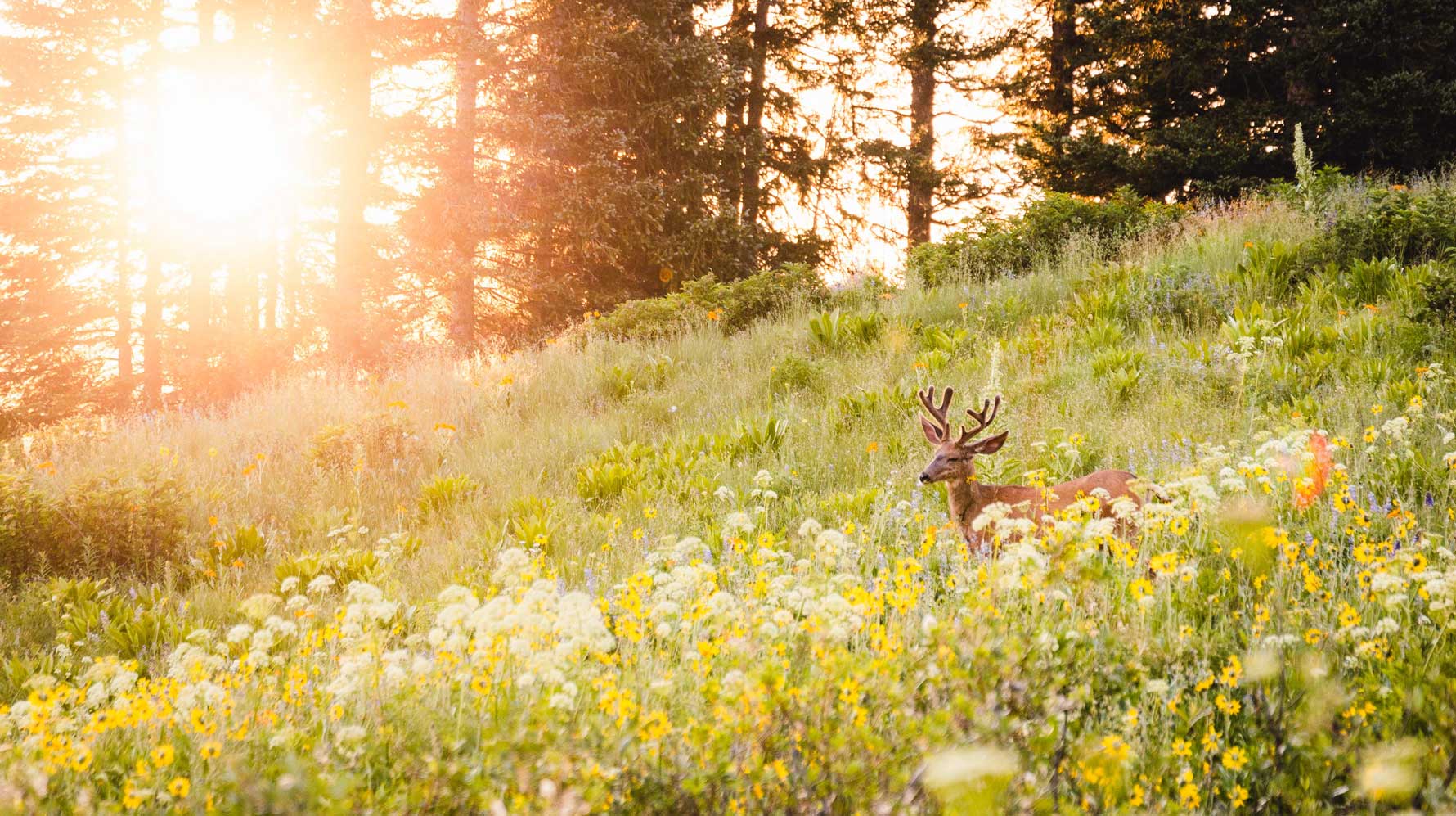
The New “Feel Guides” Honoring Bioregional Connection of Art, Ecology, Poetry
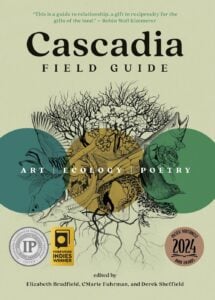
MFA in Poetry Director Elizabeth Bradfield shares her perspective on the growing movement of bioregional “feel guides,” books that blend art, ecology, and poetry to help readers connect with the places they call home. Drawing on her experience as a co-editor of the award-winning Cascadia Field Guide: Art, Ecology, Poetry, she reflects on how these guides are resonating with scientists, teachers, and readers alike. She also offers a behind-the-scenes look at how the book came together, providing a road map for anyone hoping to create a feel guide for their own region.
There is an exciting movement afoot at the intersection of art and ecology, one that taps into a desire to connect with place deeply and genuinely, that challenges the primacy of science and acknowledges the value of emotional and creative connection as essential to our sense of place. It is made manifest in the emergence and astounding success of books like Robin Wall Kimmerer’s Braiding Sweetgrass and also the bioregional “feel guides” that have been published or are forthcoming for Cascadia, Alaska, the Rocky Mountains, the Great Basin, and region from Cape Cod to Nova Scotia.
The term “feel guide” was coined by J. Drew Lanham in his endorsement of Cascadia Field Guide: Art Ecology Poetry, and it’s perfect. Yes, these books are field guides, highlighting and providing information about the plants, animals, and unique features of a region. But they also demonstrate what it might mean to love a place, to be moved by a flower, to see oneself in the life cycle of a bivalve.
Even as I have been a part of this movement, I’ve been astounded by its power. Teachers are using the books as models in all kinds of classrooms—environmental science, literature, high school language arts, nature centers—inviting their students to learn about the places they come from by creating their own feel guides. As one of the creators of Cascadia Field Guide: Art, Ecology, Poetry, alongside CMarie Fuhrman and Derek Sheffield, I can attest to the power of that work to change its maker.
Cascadia Field Guide was published in 2023 and immediately sold out of its first print run, then its second. It received a Pacific Northwest Book Award and many other honors. As we toured and gave public readings, again and again we heard from scientists how this book reflected the feelings their scientific publications couldn’t. Readers not comfortable with scientific jargon welcomed a new way of learning. There is a hunger for this type of book.
I have received emails from people around the United States and abroad who wish to create their own regional feel guide, and I hope they do. And I hope that they work with a publisher who also has strong ties to that region. These guides are not a series in the traditional sense; they are rising organically and being created and published by locals with deep ties rather than led by a single publishing house. Editors are taking different approaches, adding different elements driven by their own expertise and interests. This, too, is true to the ecological, connective spirit they embody.
Here, I want to share some of the origin story of Cascadia Field Guide so that others who wish to begin a project of their own might have a road map.
The Book: Inside Cascadia Field Guide
Cascadia Field Guide is both anthology of poems; an art book; and an ecological field guide with scientific, experiential, and cultural information. It centers the Cascadia bioregion, which stretches from Southeast Alaska down to Northern California, from the Pacific Ocean to the Rocky Mountain Continental Divide. The book is organized into thirteen communities—Salish Sea, Tidewater Glacier, Shrub-Steppe, Urban Shore, Willamette Valley—that contain ten or so beings each that are iconic or unique to the region—Sockeye Salmon, Thimbleberry, Hoary Marmot, Banana Slug. Together, these elements invite connection through fact and information, creativity and knowledge, play and accuracy.
In the book, we refer to all included as “beings” rather than “species,” because it is less clinical, more community-minded and connective. Each being is engaged by a poem, a piece of visual art, and a “being story.” My collaborators and I wrote the being stories with emotion and connection—humor, wonder, and sorrow—even as they give the reader information like size, lifespan, demography, unique anatomy. We imagined how we’d talk to a smart twelve-year-old we loved. If a being has a known importance either in ceremony, utility, or kinship to Indigenous people, we share that too, when we can (because some stories are not ours to tell, in those cases we direct people to seek out knowledge keepers who they might learn from).
I think of this kind of writing as “soft science” in the best way, and I learned that it is harder to write than a traditional natural history. The amount of research behind a 500-word being story is vast, and choosing what to include, what to highlight, and how to make it a delight to read takes a lot of work. That’s not a bad thing. I learned so much in the writing of this book, and I know that teachers say the same of their students when they teach it. Sometimes, it’s not the “big wow” of an Orca that has the most impact, but the opportunity to look more closely at beings like Banana Slug or Mosquito.
The visual power of the art in the book works a secret magic, too. We decided to have a single artist make work for each community, giving aesthetic diversity across the book as a whole but cohesion within each community. We wanted the art to be expressive of personal connection, so while some art is closer to scientific illustration, other artists are looser and more playful. Chloe Cavanaugh’s formline art links Bull Kelp, Fireweed, and Chum Salmon within the Tidewater Glacier community. Rachel Kessler’s cartoon-esque ink paintings give personality to Steller’s Sea Lion, Snowberry, and American Crow in the Urban Shore community.
To find poems for the book, we looked first to our shelves. We wanted to cast a wide net, but it was also important that the writers had a real connection to the region, even if they’d moved away or only arrived recently. We wanted to reflect the diversity of the people here and also a diversity of poetic approaches. Important and influential voices like Gary Snyder, Ursula K. LeGuin, Theodore Roethke, and Denise Levertov had to be included.
There are also writers like Rick Barot, Lena Khalaf Tuffaha, and Robert Lashley who typically don’t write “nature poems.” We asked them if they’d be willing to try—and their poems grace these pages, too. In fact, some writers who created original work were grateful to be invited to the table, as they are not often considered as part of this type of community.
The Road to the Book: How a Feel Guide Takes Shape
Derek approached me in the fall of 2019. He’d seen and admired The Sonoran Desert: A Literary Field Guide (U Arizona Press, 2016) and A Literary Field Guide to Southern Appalachia (U. Georgia Press, 2019)—would I want to work on a book like this for the Pacific Northwest? I had been thinking along the same lines about creating one for Coastal New England, where I’ve lived and worked as a naturalist for thirty years. I immediately said yes.
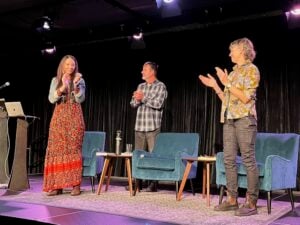
Derek and I had many conversations about who might be a good “third” for the book—someone who was fluent in literature, art, and science and who would bring another perspective and worldview to the work. We valued and trusted that different perspectives would create a stronger whole. CMarie was the perfect fit. The three of us had roots in different areas of Cascadia and brought different perspectives and different literary circles and expertise.
An avid birder who created a co-taught course with a biology professor at Wenatchee College, Derek knew the Cascade Mountains and high desert intimately. CMarie lives in northern Idaho, is a hunter, and knows rivers as well as any biologist, what’s more, she has works and lives from a foundation of Indigenous pedagogy and community. My years as a marine naturalist on the Inside Passage of BC and Alaska extended us out to sea.
In assembling an editorial team, a balance of personalities is helpful, too. Who will be the best secretary? The best cheerleader? The most visionary? The techie?
We began slowly, trying to think about how we might shape a book that was truly distinctive. It would have been easy to follow the direction laid by the Sonoran and Appalachian guides, which used Linnean taxonomy and the scientific language of a field guide. In the end, however, that did not feel right. We eventually came to a structure and voice that would encourage and highlight connection. The communities speak to ecological groupings, but they also ask us to think about and honor what it means to have Elk bugle over Pinedrops on the flanks of Mount St. Helens / Loowit.
I don’t want to understate how much work this book was. The organizational and secretarial work of keeping track of all these details was quite something. Writing the being stories was a lift, too. I’m grateful for every bit of it. In fact, in 2027 I’ll publish Cape Cod to Nova Scotia: A Literary Field Guide to a Changing Ecoregion with my collaborators Samaa Abdurraqib and Ian Ramsey. It was wonderful to work with a new team on another region I love, with a different publisher, and even though I’d learned from the bumps in the road in making Cascadia Field Guide, it was still a momentous project. I can’t wait to sing it into the world next spring alongside the other field guides sprouting up all over this beautiful planet.
Elizabeth Bradfield directs the Poetry Concentration in the Graduate Program of Creative Writing. The author of five individual collections of poems in addition to three collaborations, winner of the Audre Lorde Prize in Lesbian Poetry, and recipient of a Wallace Stegner Fellowship at Stanford University, she can often be found on a boat with binoculars. www.ebradfield.com
Meet the Expert
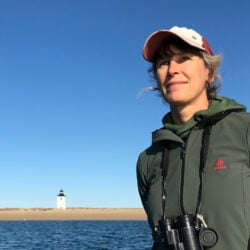
Elizabeth Bradfield
Poetry Concentration Director
Writer/Naturalist Elizabeth Bradfield’s work-both on the page and off-centers interdisciplinarity, collaboration, and connection. She is the author of five collections of poetry, “SOFAR,” “Toward Antarctica,”…
MA or MFA in Creative Writing
Interested in growing as a writer? Western’s low-residency Graduate Program in Creative Writing offers MA and MFA degrees with concentrations in Nature Writing, Genre Fiction, Poetry, EcoPoetry, Publishing, and Screenwriting.
Related Stories