MyWestern
 Academic Calendar
 Bookstore
 University Catalog
 Athletic & Recreational Venues
 MyWestern
 Academic Help
 Library
 Health & Wellness
 Campus Map
 Events

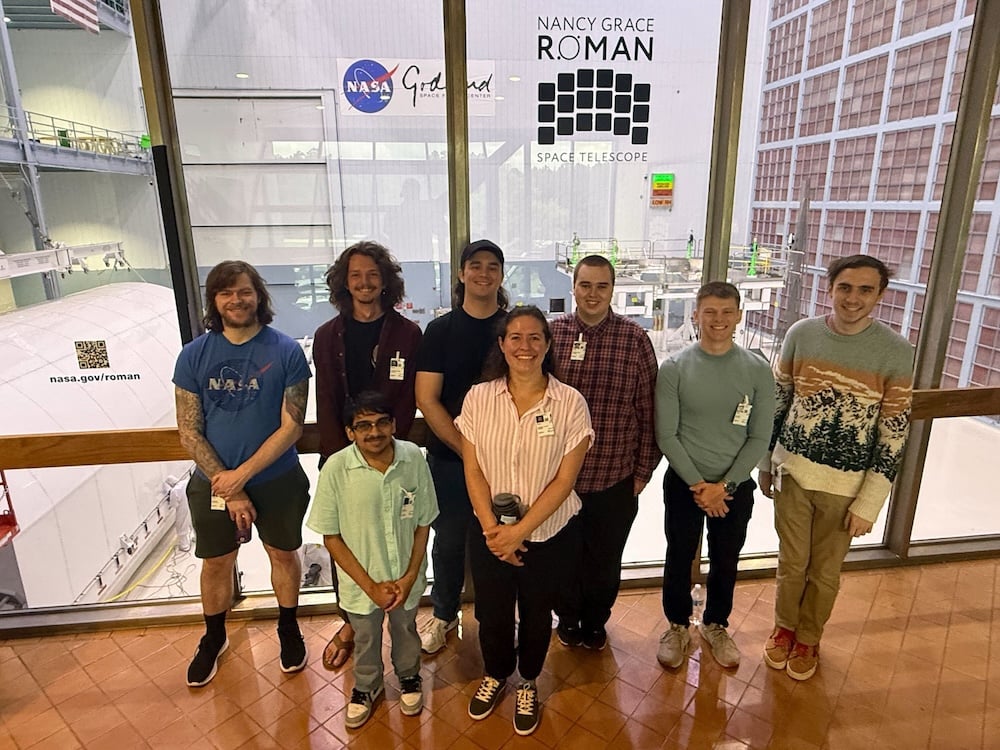
When Western Colorado University students Jacob Magoun and Justin Mills first answered a call to help search for distant planets at the Gunnison Valley Observatory, they had no idea it would eventually lead to an internship with scientists at NASA’s Goddard Space Flight Center.
But getting from a telescope in Gunnison to Goddard’s Greenbelt, Maryland campus isn’t as unlikely as it seems.
Western physics professor Dr. Suzanne Taylor is part of a network of scientists involved in TESS, the Transiting Exoplanet Survey Satellite, an MIT-led NASA mission aimed at learning more about planets orbiting stars outside our solar system.
Part of her work requires student volunteers who use the computer-controlled telescope she keeps at the Gunnison Valley Observatory to track and gather data on what might turn out to be exoplanets. When she announced last year to her astrophysics and physics classes that she needed help, Magoun and Mills stepped up.
A little more than a year later, both were headed to the nation’s largest organization of scientists, engineers, and technologists working to build the tools used to study our solar system.
“There’s no other way to describe spending a week at Goddard than awesome,” Magoun said. “Sitting at a desk and knowing you’re surrounded by some of the brightest minds and leading researchers in astrophysics and cosmology is a truly surreal experience.”
The eight-week program, which is mostly conducted remotely, is led by Dr. Rob Zellem, a NASA astrophysicist who has devoted his career to the observation and study of exoplanets, and plays an advisory role in a collaboration between Western, Colorado Mesa University, and the City University of New York.
During the week they were at Goddard, Magoun and Mills, along with six other students, toured parts of the 1,270-acre campus, including the facilities that house the cutting-edge Laser Interferometer Space Antenna (LISA) project and NASA’s new $4.3 billion flagship observatory, the Roman Space Telescope, which will launch later this year.
But the main reason they were at Goddard was to see how real research into exoplanets is done and, hopefully, find the small anomalies in a vast starry sky that might represent a planet orbiting a distant star. With several potential exoplanets identified for observation, the cohort is spending the rest of the summer meeting twice weekly with Dr. Zellem and analyzing data, with the ultimate goal of writing a paper for submission to a scientific journal.
“As a mentor, Rob is different from anyone I’ve worked with before, and the thing that makes him so effective can also be very frustrating: he won’t answer questions. Rob’s main goal for us was to learn how to do research and answer our own questions,” Magoun said. “This meant spending hours reading through papers and poking around open-source code repositories.”
After leaving Goddard, each of the eight interns is also working on an individual project, many of which are focused on the digital infrastructure surrounding exoplanet tracking and research.
Mills’ individual project combines astronomy with computer programming.
He’s writing Python software that will automatically synchronize information from NASA’s Exoplanet Archive with the well-known Swarthmore Transit Finder database, helping amateur astronomers around the world plan more accurate observations of planetary transits.
“When I heard about this opportunity to go to NASA, I thought it would be great to get my foot in the door and create a good contact with Rob,” Mills said. “I don’t really know if I want to do exoplanet studying for the rest of my life. It’s a lot of data processing … but it was good to see the inner workings of what I might want to do. I got to see so much more of what goes into being an astrophysicist.”
Last year, when Dr. Taylor received a $30,000 grant to support students interested in studying exoplanets, the internship hadn’t quite taken shape. But now that the first cohort is midway through, she can see that it was an opportunity unlike almost any other program could offer.
“The students are getting a lot of experience with the research process, and if they successfully publish a paper, that will be huge for getting into grad school,” Dr. Taylor said. “This is the first time we’ve had this internship, but we hope to be able to support additional students in a similar manner in the future.”
Want to be a part of the story?
Explore the natural world in a community of curious minds and committed changemakers. In the Natural & Environmental Sciences Department, you’ll work alongside faculty and peers—conducting research, asking big questions, and finding solutions that matter.
Related Stories