MyWestern
 Academic Calendar
 Bookstore
 University Catalog
 Athletic & Recreational Venues
 MyWestern
 Academic Help
 Library
 Health & Wellness
 Campus Map
 Events

It was the first day of her first class teaching communications at Western Colorado University, and Toni Todd looked out at a room full of listless students, wondering if she’d made a mistake.
Leading up to her big debut, she’d imagined a lively exchange of ideas and students engaged with the lecture she’d prepared. Instead, her audience mostly hoped to go unnoticed.
But one student stood out.
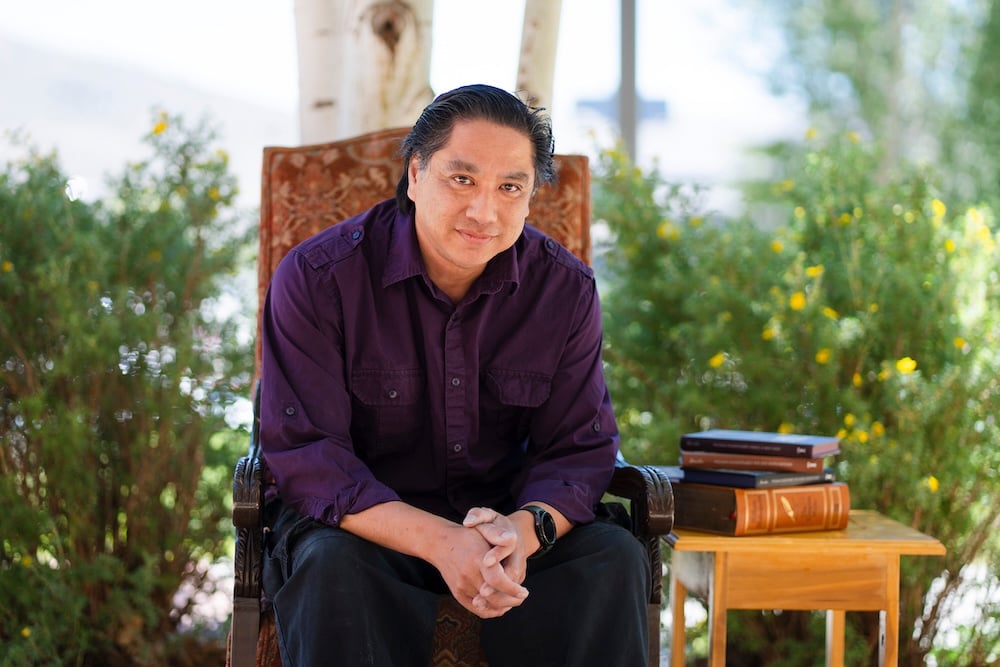
Doug Hankins was starting, or rather restarting, his own time as a student at Western after stepping away for a few years, and Todd’s Media Writing 241 was the first class he signed up for on his second attempt at a bachelor’s degree.
Nearly two decades before, as a student at Niwot High School on Colorado’s Front Range, Hankins’ guidance counselor had noticed that he would be graduating with a respectable GPA and asked if he’d thought about going on to college.
It was late in the process, and most of his classmates had already applied and been accepted to college. So when Hankins said no, he thought that would be the end of it. But it was just the beginning of a journey he wasn’t expecting to take.
“Back when I was younger, planning ahead wasn’t really a strong suit of mine. I just kind of lived in the moment and flew by the seat of my pants,” he said. “So it was kind of crazy when they said, ‘Yeah, you could get into college.’”
Second Chances
It was the mid-1990s, and what was then Western State College of Colorado was a young student’s dream. Hankins enrolled as a Communications and Theater major and imagined himself with a career in radio. “But my first round of college wasn’t so good,” he said, “I informally majored in partying and minored in girls.”
The result was predictable. His grade point average slid to a 2.3 and, on a recommendation from Western’s counselors, at the end of 1997, he withdrew from classes and found a job.
Newly unmoored, he floated around Gunnison doing a little bit of everything: retail, food service, and other entry-level jobs. After a while, Hankins had come to accept that he might never go back to college, believing he just wasn’t cut out for it.
However it was also hard to look down the road and realize he had no idea what he would do with his life. Slowly, he sank into despair about the path ahead. Then, one day, he was talking to his mother with no end or change in sight, when she asked him if he’d ever considered going back to school. “Not really,” he said.
But, like the high school counselor, she pushed him, knowing it would be good for him to get back into the classroom and exercise his active mind. “Hopefully it’ll help you out of this mental funk that you put yourself in,” she said.
At about the same time, a full-time job on Western’s custodial staff opened, and Hankins stepped through the open door. In the grand scheme of things, it was a small change of course that would set him on an entirely new path. After his first year of service with the University, he became eligible for the employee tuition benefit, which allowed him to take up to six credit hours per semester free of charge. His only cost was textbooks.
The tuition benefit was a “godsend,” allowing him to pursue a degree without fear of taking on debt. Without it, he’s not sure if he would have ever gone back. But after his first year as an employee at Western, and 17 years since he’d been a student, he was ready to return to the classroom.
“There are little things that you learn outside of the classroom that help you grow as an individual, professionally and personally. Those are the things that you retain and that resonate with you and build you up as a person,” he said. “I guess that motivated me to make sure that I was present in the classroom, that I had something interesting to contribute to the learning experience.”
In his Media Writing class with Toni Todd, he found a subject he really enjoyed and a professor whose style spoke to him. From that class on, through the rest of his undergraduate education, he would start every semester by checking to see if he could take a class Todd was teaching.
“It’s always nice to have a non-traditional student in your class,” Todd said. “It’s kind of like having a ringer. You have somebody who’s a little bit older and a little wiser, with a little bit of life experience, and their perspective is different. And so when they contribute to class discussions, it elevates the level of discourse dramatically.”
As in his schoolwork, Hankins excelled in his role as a campus custodian, where he continued to work 40 hours a week year-round, regardless of his course load or the classwork due. Soon, he was promoted to supervisor and some of the work-study students he managed during the day turned up beside him in class. Between work and classroom discussions, the students got a fuller picture of who Hankins was as someone who had made some mistakes, learned from them, and then returned to set the example of what positive life changes can look like.
Full Circle
For the next 12 years, Hankins took one class each semester and occasionally two, seemingly motivated by the promise of a degree. But the further along he got, the less it became about graduation.
He delved deeper into Western’s course catalog, finding classes that matched his interests and took him beyond the traditional communications curriculum. He built stage sets for summer theater productions, took Gothic literature, sampled a Recreation and Outdoor Education course, and even enrolled in an honors class examining ghosts and the afterlife through the lens of critical thinking and science.
“I’ve sampled a little bit of everything off the menu,” he said. “I’ve also taken some really amazing sociology and psychology courses, and learned a lot about myself over my time here at Western. Sure, I could stay in my own lane, but there’s just so much to experience. I think that’s one of the really cool things about being able to spread out and cherry-pick cool courses from different departments, and just experience what Western has to offer.”
A lot had changed since Hankins first enrolled at Western as a teenager, including the radio business. But his love for the medium never faded. In one of his Strategic Communications courses, students were asked to study a local organization and develop recommendations to improve it. Hankins chose Western’s student-run radio station, KWSB, where he’d worked as a young student.
That class assignment soon evolved into an independent study, and he started spending time with the station’s staff, helping where he could and looking for ways to support students. Then, almost without noticing, Hankins found himself doing much of the work of an advisor.
One day over coffee, Todd told him she had a lot on her plate and asked if he’d consider stepping into a bigger role at the station. “How much work is it going to be?” he asked. “Honestly,” she told him, “you’ve already been doing it.”
With that, his time as a student was over as he stepped into a different role altogether.
“If I had to guess, Doug thinks of his education not as a means of changing his life, but as a means of enhancing it. And that really is the purpose of college,” Todd said. “It’s not just about mastering a certain skill and then being able to apply it in the job market. You learn to think critically, you learn to see the world from different points of view. And I think Doug understands that.”
When he walked across the stage in May to receive his diploma cum laude, he was a changed person, with a 3.5 GPA, a renewed curiosity about the world, and a deep love of learning. But it wasn’t the start of a new chapter, like he once thought it would be.
Graduation, he said, was “just another day.” He’d still show up for work the following Monday. He’d still advise students at KWSB. He’d still be searching for new ways to put his education to use and for new things to learn. “The big thing is just finding contentment and happiness with what you’re doing. And yeah, it has been a journey. But I’m happy. I go home and sleep well at night.”
Related Stories