MyWestern
 Academic Calendar
 Bookstore
 University Catalog
 Athletic & Recreational Venues
 MyWestern
 Academic Help
 Library
 Health & Wellness
 Campus Map
 Events

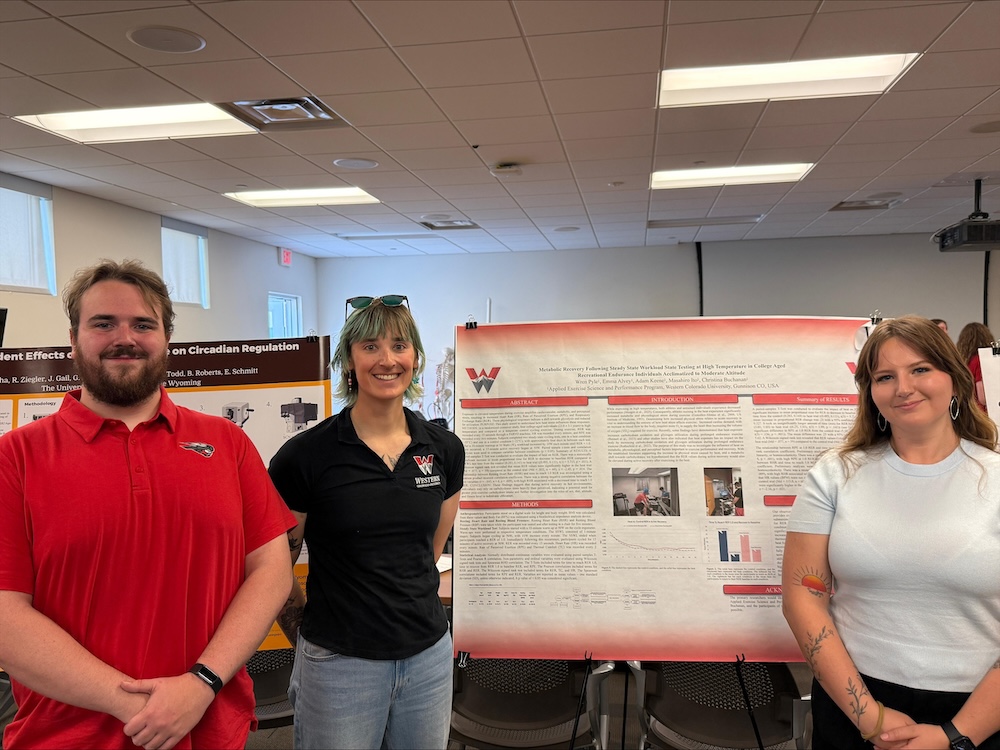
A group of first-year graduate students in the Applied Exercise Science and Performance program from Western Colorado University presented their research alongside master’s students from some of the largest institutions in the region at the Rocky Mountain American College of Sports Medicine Conference, April 10 and 11, and earned top honors in the poster presentation competition.
“It’s very significant,” Associate Professor of Exercise and Sport Science, Dr. Michelle Conway, said. “They earned first place in the master’s student poster category out of a total of 11 posters from a variety of schools, many of which have substantially greater financial and research resources than Western.”
Part of what made the research so significant was the time it took the team to complete it. While many of the other posters were based on master’s theses that had been developed over the course of a full year, or more, Western students Emma Alvey, Adam Keene, Wren Pyle, and Masahiro Ito completed their project as part of a single-semester course.
Through their research, they were interested in learning how heat affects the body’s use of energy during and after exercise. By asking four recreationally active college-aged adults to pedal an exercise bike up to a set level of exertion, once in a room around 70 degrees and again in a room at 95 degrees, they were able to track how quickly the body shifted to using carbohydrates and how long it took to recover.
“It showed what they’re using metabolically, fat or carbs. And what we found is that they were metabolizing carbohydrates faster in the heat than at room temperature,” Keene said. “Another really important finding was that the Rating of Perceived Exertion (RPE) we tested was exactly the same in both tests, meaning they didn’t perceive any increase in difficulty in either room, even though there was a metabolic increase.”
The findings showed that the body shifts more quickly to carbohydrate use and takes longer to recover when exercising in heat, even if the effort doesn’t feel more difficult.
The study was conducted as part of a 12-week Research Methods course taught by Dr. Christina Buchanan, with the team taking their full research process, from approval from Western’s Institutional Review Board to data collection and analysis, on a compressed timeline.
“It took us two weeks to get everybody in and complete their baseline,” Alvey said. “We had to measure their body weight, height, BMI, and body fat percentage. Then we told them the parameters: please don’t drink caffeine and don’t do hard exercise 24 hours prior to the study. After some scheduling conflicts, we got two weeks of research done.”
For the students, the conference and poster competition not only validates their findings but also their ability to contribute to the field so early in their graduate careers, while competing against more senior teams.
“Student-focused conferences such as Rocky Mountain ACSM provide valuable exposure to a wider range of institutions, research, and perspectives,” Dr. Conway said. “These events also offer excellent networking opportunities, allowing students to connect with peers and faculty, which can support future educational and career opportunities.”
While the study is over, the research itself may not be finished. With a larger sample size, the students believe the study could be expanded and potentially published, opening the door to future research, including in cold-weather conditions.
“I know at least two of us are looking into pursuing a PhD,” Keene said, adding that he’s sure the experience will contribute to their future goals. “So this was definitely a great start.”
And when the data finally came together, the significance of the work was clear.
“I think we were together when we were running the stats. We saw the data table come up, and we were so happy,” Alvey said. “We texted Adam, and we’re like, we got the results, and it’s significant. We did something!”
Push the limits of human performance.
Advance your expertise in exercise science through Western’s Applied Exercise Science and Performance master’s program and gain the research experience, advanced training, and hands-on skills to lead in human performance, health, and exercise physiology.
Related Stories