 MyWestern
 Academic Calendar
 Bookstore
 University Catalog
 Athletic & Recreational Venues
 MyWestern
 Academic Help
 Library
 Health & Wellness
 Campus Map
 Events


It was the summer of 1979, and a group of high school and college wrestlers from around the state gathered beneath the trees at Spring Creek Resort to work on their technique with the legendary Western coach Tracy Borah, who had coached teams to two national championships in the previous decade. At his Rocky Mountain Wrestling Camps, he and his team of veteran coaches taught some of the best high school wrestlers of the day.
But standing off to the side, quietly watching and waiting for his chance, was the future.
Miles Van Hee was the youngest in a line of Colorado wrestling royalty, spending his summers going to camps and competitions with his father, Tom, a good friend of Coach Borah’s, who would go on to coach the Fowler High School wrestling team to four state championships in the 1980s. Miles’ older brother, Brent, was only the fourth person in state history to win a championship all four years of high school.
“My dad would always bring his team up to the Rocky Mountain Wrestling Camps, and he would drag me along as a kid,” Van Hee said. “That’s how I fell in love with Western.”
All along, he was absorbing the techniques and values of a sport that would shape the rest of his life and teach him what it takes to win.
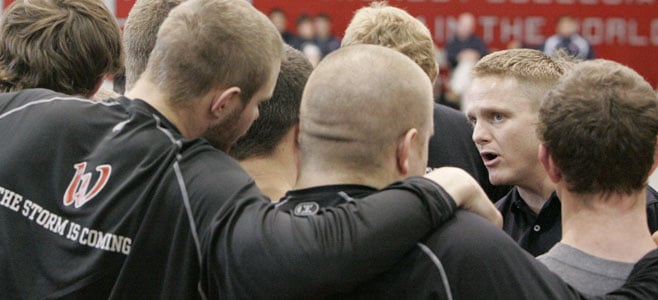
What’s in a name?
With the Van Hee name, Miles went into high school with a target on his back. But no one in the league could beat him. In his freshman year, after going undefeated in 1A competition, he won the state championship at 98 pounds. Then, in his sophomore year, he won the state championship again, pinning his opponent in 1 minute and 37 seconds.
Then, in what turned out to be a prescient comment, a 16-year-old Van Hee told a reporter for the Rocky Mountain News, “I tried not to think of the pressure. In wrestling, there’s always a chance that you can be upset.”
The following year, facing a tough bracket, he lost in the first round of the state tournament. His opponent would go on to win the state championship that year.
Upset was an understatement. But the loss only made him want to win even more. In his senior year, he saw that the two finalists from the previous year’s tournament, including the one who had beaten him in the first round, were wrestling at 119 pounds. So Van Hee gained weight to chase them.
Beating them both to win the championship that year made it the sweetest of his three and earned Van Hee the title of State Tournament Wrestler of the Year.
“That loss in my junior year transformed my life. With that loss, I couldn’t be a four-time state champion anymore,” Van Hee said. “It allowed me to focus on becoming a better wrestler. And it would make me a better coach.”
Finding a way home
Such a standout high school career garnered a lot of attention from college coaches, and Van Hee had his pick of programs. But because his brother opted to wrestle for Western and his father’s connection to Coach Borah, it was widely accepted that Van Hee would become a Mountaineer.
But at the last minute, he decided to chart his own path and accept an offer to wrestle at Northern State University in Aberdeen, South Dakota. “My older brother Brent went to school and wrestled here at Western,” he said, “and I just wanted to go somewhere different.”
Van Hee liked his team and his coaches and almost stayed for a second year. But he was a Colorado kid with National Championship aspirations, and he felt like Western would give him his best chance to chase that dream.
He transferred into Western in his sophomore year and never looked back, racking up wins and accolades on his way to becoming a two-time All-American and RMAC champion, and an NCAA Division II West Regional champion. In 1992, he was selected as a member of the USA-Collegiate Cultural Exchange Team that toured Poland and Germany, wrestling the alternates who were hoping to compete in the Olympic Games.
But after college, the path wasn’t as clear. Growing up, Van Hee’s father had coached while he taught physical education at Fowler High School, and now he considered something similar. Then a head assistant wrestling coach position opened at Western, and the stars started to align. His second year, he was named the Assistant Collegiate Wrestling Coach of the Year for all levels by Wrestling USA Magazine. Then three years later, the head coaching job at Western opened, and Van Hee stepped right in.
“You think you’re ready for it, but you’re never really ready for it until you step into it,” Van Hee said of being a head coach. “Every year, I learned something more. The more I talked to other coaches, the more I found out what worked for me. I also spoke with my student athletes a lot; it is amazing how much you can learn from them.”
Carrying a Legacy
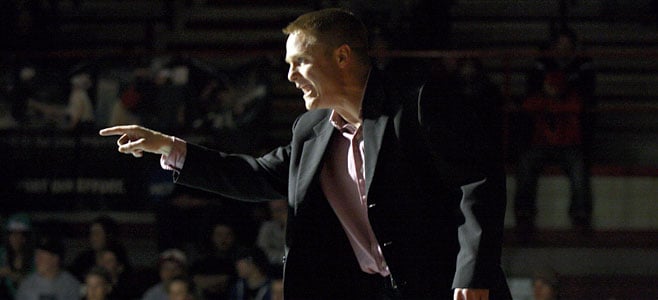
All of the lessons he’d learned following his father around to camps, or from Coach Borah, or during his career on the mat, all went into his team. And the wins followed. Over the next two decades, his Mountaineers finished in the Top 25 in the nation in every year but one, with nine Top 10 finishes.
In 1999, just two years after becoming Western’s head coach, he saw his first wrestler crowned national champion, followed by five more national champions and 55 All-Americans. During the 2017 Tracy Borah Duals, Van Hee became the all-time winningest coach at Western, surpassing Tracy Borah’s own record during the final dual win.
Van Hee’s success on the mat was recognized in 2004 when he was named the NCAA Division II National Coach of the Year. And the awards kept coming: Colorado College Coach of the Year six times, RMAC Coach of the Year four times, D2 Bob Bubb Coaching Excellence Award.
“His hands-on dedication and determination to raise the level of Mountaineer Wrestling and the Mountaineer Nation have always been full throttle. He leads by example,” longtime assistant coach and friend, Craig Otto, said. “He’s always two feet in and moving forward to help the Mountaineers attain their goals.”
When he became the head wrestling coach, he inherited the same Rocky Mountain Wrestling Camps he had gone to as a kid. Knowing that the future of his program was somewhere in those camps, he pushed their capacity to its limit. What started as a couple of hundred athletes grew to more than 1,400, and they were running out of space. “The Mountaineer Fieldhouse couldn’t have come at a better time,” he said. The future looked bright.
There were inevitable bumps in the road. Early on, some athletes were letting their grades slip, and Van Hee needed to refocus some of his team’s energy on academics. “You want to win national titles, but you also want to make sure you’re winning in the classroom,” he said. The results came swiftly, and the Mountaineer wrestlers were eventually named Academic National Champions by the National Wrestling Coaches Association for two consecutive years, in 2016 and 2017.
But Van Hee was also learning that coaches had to do a lot more than just win. He needed to raise enough money to clothe his wrestlers, get them to competitions, and feed them while they were there. If he wanted to recruit the best wrestlers, he would need to offer the most generous scholarships. Money at a regional public university had always been tight, and probably always would be. The reality was that to raise money, he needed to win, and to win, he needed to raise money.
Van Hee set to work developing the fundraising arm of his program. With the camps playing a significant role, he could focus on the annual Mountaineer Wrestling Reverse Raffle. Soon, they tripled the number of tickets sold and started setting fundraising records every year.
Leading from the Front
Throughout his career, from wrestler to coach, Van Hee had developed a unique skill set and a strong record of success. So when Western’s Director of Athletics position opened in 2017, he was a natural choice to fill it.
By then, he understood the importance of funding, not as an abstraction, but as a means of attracting and supporting Western’s student athletes, which became his top priority as Athletics Director.
Van Hee immediately started recognizing and expanding successful fundraising programs across departments. He also leaned into the Gunnison community, building relationships with business leaders and growing the number of corporate partnerships to 65.
In his nine years as Athletics Director, he pushed fundraising from about $300,000 a year to nearly $1.5 million. “In a small rural community, it’s amazing how many people support Mountaineer Athletics,” he said. “We’ve been very fortunate to have the support that we’ve had from our community, our alumni, and our donors.”
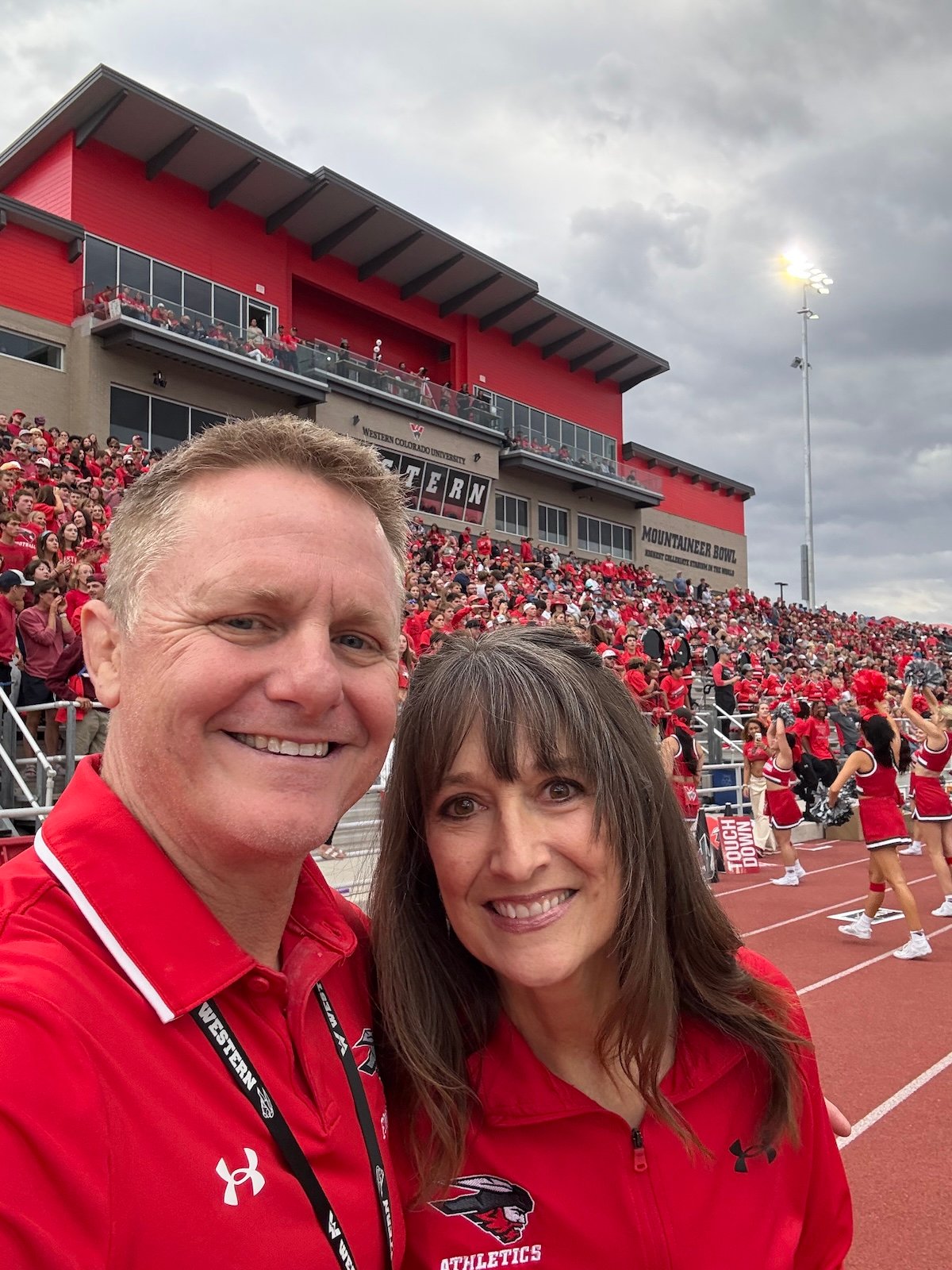
He also ushered in a new era of Mountaineer Athletics, overseeing a $44.9 million renovation of our Mountaineer Bowl Event Complex, in addition to a $2.6 million turf soccer field, renovations to both the Women’s and Men’s Basketball team locker rooms, Women’s Swimming and Dive locker rooms, and a 30-person film room specifically for Western’s Women’s teams. Five years ago, Athletics took on Western’s Division of Conference and Event Services.
“I’m seeing more and more people that I’ve never seen before come onto campus, come to a sporting event, to be a part of the atmosphere,” he said. “And we’re able to engage with people in the community that we couldn’t have if it weren’t for these facilities.”
All along, Western teams kept winning, and academics remained a priority. Last year, Western broke its own record, winning four Brechler Awards, meaning that four Mountaineer teams had the highest GPA in the conference.
“I wanted to make an impact on each program as an Athletic Director. But I knew it was going to have to be a team effort,” Van Hee said. “My success has always been with the people that I’ve had by my side, whether as an athlete in the trenches with the wrestlers, or all my assistant coaches, or now with the team we have here in Mountaineer Athletics. I’ve just been really fortunate.”
Now, as Van Hee steps away from his time at Western to pursue yet another phase of his career, he’s looking forward to seeing it all from the other side: as the fan he’s been since he was a boy, waiting for his chance.
“I’m going to be a Mountaineer forever,” Van Hee said. “I always have been, and I always will be.”