MyWestern
 Academic Calendar
 Bookstore
 University Catalog
 Athletic & Recreational Venues
 MyWestern
 Academic Help
 Library
 Health & Wellness
 Campus Map
 Events

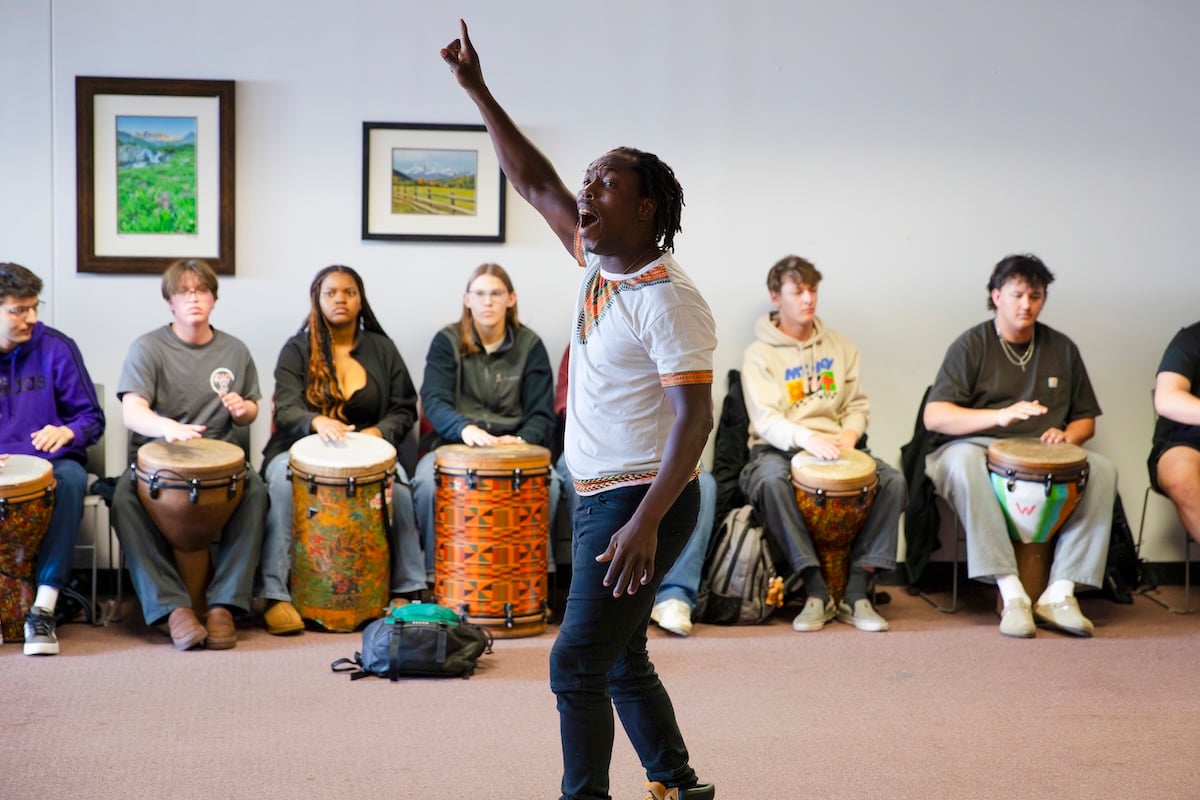
For more than two decades, Fara Tolno has been traveling to the Gunnison Valley and around the world preaching the gospel of cultural preservation. But instead of pounding on a pulpit, his message is carried by the beat of a drum.
Not unlike the way we use tone and inflection to make words with our own voices, Fara explains that the drum can speak using different sounds – a low bass achieved by bringing the palm of the hand down on the center of the drum, a slap struck with the fingers a little closer to the edge of the drumhead, and a high tone made with a quick strike near the outside edge, sharp as a pin prick.
“We’re gonna talk with our hands, and we’re gonna talk with our spirit,” he told more than 40 Western Colorado University students sitting in a circle last Thursday, February 5, each with a goblet-shaped djembe drum they held between their knees. “[Djembe] means ‘come together,’” he said, “as in ‘let’s come together to listen, let’s come together to learn from each other.’”
In Guinea, West Africa, where Fara grew up in a small village, the traditions of dancing and drumming were already starting to fade by the time he was a boy. So at nine years old, Fara started learning from one of the remaining masters.
But, like the keeper of many traditions, he noticed there wasn’t much interest from his peers. And as the next generations came along, interest waned even more. “And now I’m keeping the legacy and that tradition alive,” he said, “and without it, a lot of it would go away because there’s not a lot of master drummers or people who keep the culture alive.”
So in 1998, he came to the U.S. and started a tour to raise awareness of what was being lost. His dream was to raise enough money to build a school in Guinea where the arts of dancing and drumming could be kept alive for future generations.
Now, as the president and executive director of the Kissidugu Foundation, which was created to support his vision, he’s spreading the word of community, creativity, self-expression, and tradition.
Through his work, the Foundation has opened the Kissidugu School of Music, Dance, and Education, with 40 instructors, a pharmacy, and teacher housing, where students from across the region gather to learn. They’ve also expanded to provide the community with a garden and a well for drinking water.
In his class at Western, Fara took the students through a series of rhythmic exercises that got progressively more involved. At one point, he stopped to have the students sing in a call-and-response, pausing to offer lessons from the exercise.
“Each one of us has a different voice … You don’t have to sing like a famous person. You can sing like yourself,” he said. “Because when we sing together with the same tonality, it creates harmony. We’re also doing the work of letting go of barriers and of being shy. Anyone can sing. Believe in yourself, and you can do it.”
Related Stories