MyWestern
 Academic Calendar
 Bookstore
 University Catalog
 Athletic & Recreational Venues
 MyWestern
 Academic Help
 Library
 Health & Wellness
 Campus Map
 Events

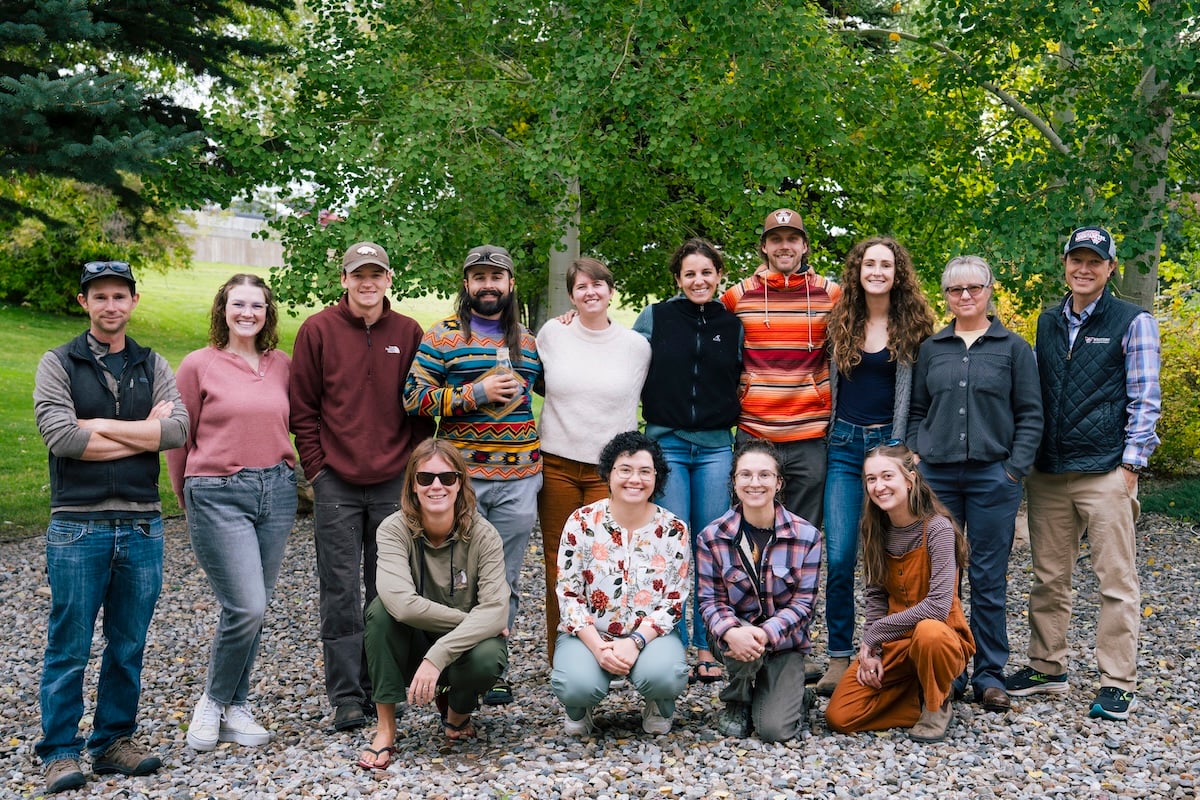
To the untrained eye, the stretch of Tomichi Creek that runs through Western’s Coldharbour Ranch looks pretty natural as it snakes back and forth between an abandoned railroad grade and US Highway 50. But to Sophia Reggiani, a graduate student in Western Colorado University’s Clark School of Environment and Sustainability, there are clues that the creek needs help.
“The railroad grade changed the way the creek flowed,” Reggiani said. “And then when the highway went through, it was contained between the railroad grade and the highway.”
In several oxbows, the creek flows uncomfortably close to the highway, pushing toward its foundation. Beyond the railroad grade are wetlands that the creek would have historically flooded onto as it adjusted its course to meet the natural conditions. But today, that can’t happen.
“That’s what we’re trying to fix,” Reggiani said. “We need to take some of the energy that Tomichi Creek has and divert it away from the highway and towards the historic oxbows and wetlands.”
Reggiani is working to start that process as part of the EMPLOYS Traineeship program at The Clark School that provides students with the opportunity to earn a research-based Master of Science in Ecology (MSE) and a Master of Environmental Management (MEM), which focuses on policy- and solutions-driven approaches to environmental challenges, all in just three years.
The EMPLOYS (Ecological Management and Public Lands Opportunities for Young Scientists) program was designed with complex problems, like those facing Tomichi Creek, in mind, where a dynamic natural system runs up against an established human system. And a solution can only be found through an understanding of both.
“It’s an interesting program because, at its core, it’s asking: how can we make graduate school more innovative and effective?” said associate professor Briget Eastep, who’s directing the program. “The approach here has been to try and build a bridge between science and management, which don’t always communicate well.”
That bridge was made possible with help and grant funding from the National Science Foundation’s National Research Traineeship (NRT) program, which supports graduate students in high-priority interdisciplinary or convergent STEM research areas.
As the relationship between people and the environment grows more complex, future leaders will need a diverse skill set to translate scientific insights into on-the-ground action. “We’re doing good science,” Eastep said. “But we’re also using technology and big data to translate that science into something managers can use to make informed decisions.”
Program alumni have leveraged that experience into roles with UC Berkeley, the Montana Division of Wildlife, the U.S. Geological Survey, and other top-tier organizations.
Reggiani, who has already completed an MSE and is set to graduate with an MEM in May, has combined her studies with an AmeriCorps Fellowship working with Coldharbour Ranch, where she’s designing, planning, and looking for funding to pay for what will someday be a major stream restoration that reconnects Tomichi Creek to its historic wetlands.
She’s also hoping her dual master’s degrees will give her a competitive advantage as she pushes on toward a PhD program. Several programs have already invited her to apply.
“I like the convergence of the two programs where you can see how they’re related,” Reggiani said. “The faculty do everything they can to support students, and the people in the program are always motivated and excited about the work.”
Lead the Change You Want to See
Join a community of bold thinkers and passionate problem-solvers. In the Master’s in Environmental Management program, you’ll dive into real-world research, work side-by-side with faculty and peers, and develop the skills to create lasting environmental impact.
Related Stories