MyWestern
 Academic Calendar
 Bookstore
 University Catalog
 Athletic & Recreational Venues
 MyWestern
 Academic Help
 Library
 Health & Wellness
 Campus Map
 Events

It was pouring rain and nearly dark outside when Sally Romero finally left her office after a long day at work. Her husband was out running the kids to practice, and she was thinking about dinner. Then she saw someone sitting on the steps outside her house, shivering and soaked to the bone.
The girl was curled into herself and crying. She said she just needed someplace to go. She was away from home, and some of the people she’d been leaning on were no longer there. In her desperation, she went to the one person she knew in Gunnison who wouldn’t turn her away.
When Sally found her, she brought the girl inside and dried her off, letting her borrow some clothes. They sat down to talk before the girl joined the family for dinner and, still unable to cope on her own, spent the night on a spare bed. She wasn’t the first one to sleep there.
Her husband and children were used to meeting Sally’s students that way. There were some, like this girl, who needed support in a time of crisis. Some students needed a place to go for Fall Break or when the dorms closed. Others just needed a home-cooked meal and a family to share it with. “My husband always jokes that it feels like we have a hundred kids,” Sally said. “Our doors at home were always open to students who didn’t have families here. We’re dealing with some really big issues.”
Starting Something Special
Sally didn’t know what to expect when she first started as the director of what was then called The Diversity Center in 1995. At the time, the department was relatively new and in need of stability. It consisted of a single office in an upstairs corner of the University Center, where no student would dare go unless they were working on the Top O’ The World student newspaper late on a Wednesday night. Otherwise, she had a bookshelf, some books, and her own determination to make a difference.
“In a way, it was really good that there wasn’t much here when I started,” Sally said, “because it let me build a program and put my own stamp on it.”
Her impact was immediate. At the time, only 3.2 percent of Western’s students identified as being non-White. But that only stoked her desire to make every one of them feel welcome, like they had an important place at Western. She walked around the University Center and asked students who were alone if they’d like a place to go. “I love people. I always have,” she said. “And I’ve always had a pretty good intuition.”
Her first order of business was to change the department’s name from The Diversity Center, which felt like it was for students who were different, to The Multicultural Center, or MCC, where everyone had a place. She wanted to create a space where differences could be celebrated, but the similarities would be hard to ignore.
To achieve that, Sally knew her second act as director would need to be physical. Recognizing how hard it would be to attract students to such an out-of-the-way location, she lobbied her mentor and boss, Vice President of Student Affairs Sherryl Peterson, to relocate to a more visible location. Soon, she was front and center on the main floor of the University Center. “We had a great big window,” Sally said. “And I think it sent a message that we’re no longer hiding, but we’re valued and visible to campus.”
A Place to Breathe
With space to offer students, Sally went to work developing today’s Amigos Club, the Black Student Alliance, the Asian Pacific Islander Club, and the Native American Student Council. She found that many of the students who were drawn to the MCC came from close-knit families and communities and found themselves in an unfamiliar place away from home for the first time. More than anything, they just wanted a place where they could hang out, listen to music, eat familiar food, and be among friends. “Everyone is welcome in the MCC,” Sally said. “You just have to have an appreciation for other cultures and a desire to share your culture with others.”
For the first eight years, she worked alone, building programming, building trust, and creating a welcoming space for students who saw themselves as cultural outliers. She joined the Admissions team on high school visits to show students of color that there was a place for them at Western. “Once I established a core group of students, our numbers just started to grow and grow.”
Eventually, she was able to hire an assistant. But more and more of the MCC’s leadership was coming from the growing ranks of students who spent time at the MCC. She offered leadership training and taught her students presentation skills. Service became a central part of students’ experience in the MCC. They read to children at a local daycare, adopted a highway, and helped the Forest Service clean up campsites. It was all in service to helping them succeed in a competitive world. “We compete for partners, for jobs, for everything,” Sally said. “You have to be prepared to present yourself in the best way possible. And so we work on that.”
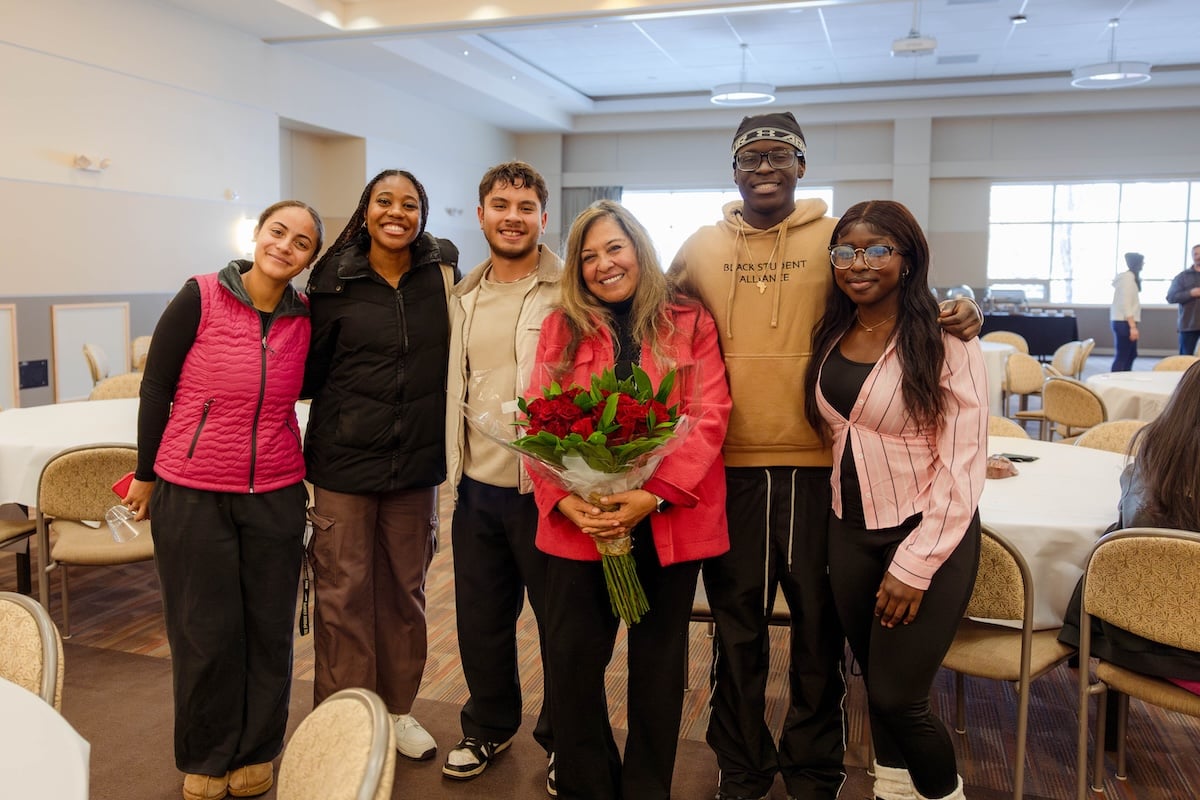
A lot of what Sally provides to students has nothing to do with academics. You can hear it in the way they call her ‘Miss Sally’. She helps them find a sense of community and feel like they have someone they can turn to for help. Sometimes she gives out relationship advice or styles someone’s hair before a presentation. Her phone is full of reminders to give students words of encouragement before a test or nudge them about work that’s coming due. “I love working with students,” Sally said. “Even more than the cultural piece, I love helping students see what makes them special.”
Sally sees it as knowing when to walk with them and knowing when to let go. Part of her role is to nurture students and recognize what they need. “It’s like planting seeds,” she said.
A Lasting Legacy
Now, as she plans to retire as Western’s Director of Unity and Belonging at the end of 2025, hardly a student has passed through the MCC who wouldn’t mention Sally as being an essential part of their Western experience. When former students accept awards, they often gush about her influence from the podium. Sometimes, former students drive hours to take her out to dinner so they can announce an engagement, a birth, or a big promotion. And when word of her retirement got out, she was inundated with hundreds of cards, calls, and well-wishes.
Recently, her grandson had a medical emergency that required hospitalization at Children’s Hospital Colorado. While the family was there, they got a call from Dr. Carlos Rodriguez, a senior instructor at the CU Anschutz Medical Campus and a Western alum who had seen the family’s name on a list and wanted to pay his respects to Sally, whom he credited with the start of his success. Similar things happen seemingly everywhere she goes.
The impact Sally has had on her students is hard to overstate. When the University Center was renovated in 2009, the Multicultural Center was given a large and prominent location on the main floor, because of the prominent role it plays on campus. Today, nearly one-third of Western’s students are not White, and last semester, MCC-sponsored events attracted more than 9,000 participants in total. At any one time, dozens of students are being served in big ways and small by the program she built.
“It’s been an amazing journey. I feel really privileged that Western allowed me that opportunity and that we’ve seen such tremendous growth in my time here,” Sally said. “Because 30 years is really a long time.”
Related Stories